Precision, cold-chain integrity, and logistical velocity. Discover how Nova Vora coordinates an asset-light export model connecting Kenyan pastoral rangelands and orchards directly to international airport terminals.
Traditional agribusiness often carries heavy fixed asset overhead—owning processing plants, cold rooms, and vehicle fleets. This ties up capital and limits flexibility.
Nova Vora Fields Limited operates an **asset-light outsourced model**. We focus our capital and management energy on what genuinely determines commercial success: stringent animal and fruit selection, on-site quality assurance, regulatory documentation, and cold-chain compliance.
We contract physical slaughter, deep chilling, blast freezing, and packaging to established export facilities with active licenses from the Kenya Directorate of Veterinary Services (DVS) and destination authorities (e.g. UAE MOCCAE). We then supervise each batch with our own dedicated on-site personnel.
Our Commitment: We do not own slaughterhouses or cargo airlines, but we govern every step of the supply chain with institutional precision.
From pastoral rangelands to airport cross-docking, every consignment follows an eight-stage controlled protocol.
Aggregating healthy small ruminants (Galla goats and Small East African goats) from primary pastoral rangelands in Northern and Eastern Kenya. Animals undergo ante-mortem health vetting and visual weight screening (18–24 kg live weight).
Animals are held in shaded, ventilated lairage pens at the contracted export abattoir for a mandatory 12 to 24 hours with free access to clean water. This resting phase restores muscle glycogen levels, preventing high-pH dark-cutting meat.
Slaughter is performed manually by practicing Muslim slaughtermen strictly following GSO 993/2015 under resident Halal certifier supervision. Resident Kenya DVS veterinary officers conduct post-mortem examinations and apply official food-grade stamps.
Dressed carcasses are transferred immediately into forced-air chilling rooms held at 0°C to +2°C for 24 hours. Deep muscle temperatures are driven below +4°C before packaging to arrest microbial activity and establish shelf-life stability.
Chilled carcasses are wrapped in breathable, food-grade 100% cotton stockinettes (muslin wrap) to prevent surface contamination while preserving moisture balance. Dual-language (Arabic/English) waterproof export tags are affixed per GSO 150-1.
Pre-cooled refrigerated trucks (holding valid DVS Certificates of Meat Transport) transfer wrapped carcasses at 0°C to +2°C from the abattoir cool rooms directly to the Cargo Perishables Terminal at Jomo Kenyatta International Airport (JKIA).
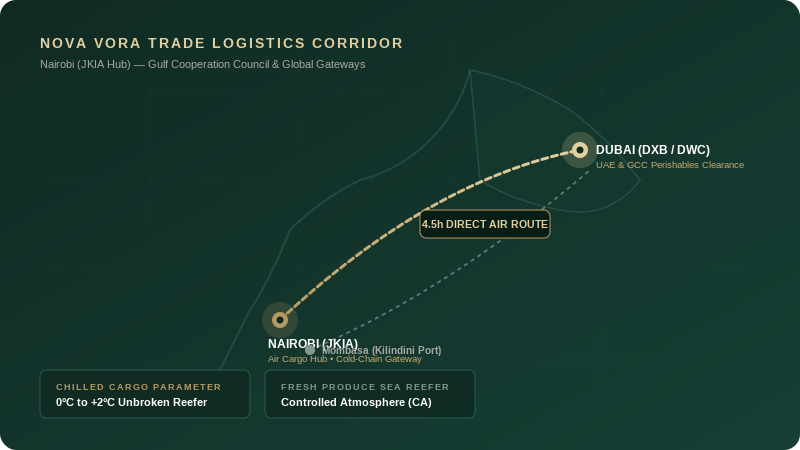
Consignments clear Kenya Revenue Authority Customs (C17B entry) and DVS export release (Form VS28). Cargo is palletized and loaded into temperature-controlled aircraft holds for direct flights to Dubai (DXB/DWC), taking 4.5 to 5 hours.
Upon landing at DXB, cargo moves into dnata Perishables cool rooms (0°C to +2°C). Following destination port health inspection, cargo is released to the approved commercial buyer strictly per agreed documentary payment terms.
Delivering orchard-fresh fruits, crisp fine vegetables, and aromatic culinary herbs through structured packhouse handling, KEPHIS inspection, and fast cold-chain transit.
Mangoes (Apple & Ngowe) and multi-variety avocados (Hass, Fuerte, Pinkerton, Jumbo) are hand-harvested by vetted smallholder growers at verified maturity indexes (e.g. minimum 23% dry matter for Hass avocados). Fresh fine vegetables (extra-fine French beans, snow peas, sugar snaps) and delicate culinary herbs (sweet basil, rosemary, thyme, mint, chives) are selectively picked during early morning hours to preserve crispness and essential oil integrity.
Harvested produce is transported in clean, ventilated plastic field crates under protective tarpaulins to a KEPHIS-registered packhouse facility located along the Nairobi or Machakos agricultural corridor within hours of picking.
Export mangoes undergo supervised Hot Water Treatment (HWT) at 46°C–48°C for 60–90 minutes to ensure total fruit-fly biosecurity compliance. Avocados and fine vegetables receive chilled sanitizing wash cycles, while fresh culinary herbs undergo gentle pneumatic sorting and manual inspection.
Produce is mechanically or optically graded by weight, caliber, and surface class. Fruits are placed in 4.0 kg net telescopic cartons with protective dividers; fine vegetables into 1.5 kg / 2.0 kg punnets or cartons; and culinary herbs into 100g–500g micro-perforated breathable sleeves.
Cartons are stacked onto heat-treated standard pallets (ISPM-15 compliant) and transferred to forced-air pre-cooling rooms. Temperatures are stabilized specifically per commodity: +1°C to +4°C for fine vegetables; +4°C to +8°C for culinary herbs and avocados; +8°C to +12°C for mangoes.
Fresh fine vegetables and culinary herbs are dispatched via scheduled direct air-cargo flights from JKIA within 24 to 48 hours of harvest. Mangoes and premium avocados fly on scheduled widebody services to UAE and Gulf hubs, while volume avocado shipments utilize 40ft Controlled Atmosphere (CA) sea reefer containers via Mombasa (10–14 days transit to Jebel Ali).
Our logistics operations leverage Kenya's premier international transport hubs, connecting national production basins with key global markets.
Primary Gateway: Chilled Meat & Premium Air Produce
East Africa's leading airfreight hub, handling over 350,000 tonnes of perishable cargo annually. Equipped with modern cold cross-docking sheds, on-site DVS and KEPHIS inspection posts, and daily direct widebody flights to Dubai, Doha, and European hubs.
Secondary Gateway: Volume Horticultural Sea Reefer
The principal maritime port of East Africa. Utilized for 40ft Controlled Atmosphere (CA) sea reefer container shipments of Hass avocados and frozen commodities, offering competitive logistics economics (10–14 days transit to Jebel Ali).